


Overview
Walmart Mexico was evaluating electronic shelf label designs that would ultimately be experienced in physical retail stores. The team needed to compare existing US label formats with locally designed Mexican alternatives while evaluating typography, color, information hierarchy, shelf position and accessibility under realistic viewing conditions. Reviewing the labels only in Figma was not enough because customers would see them from different distances, heights and angles, surrounded by products and other in-store visual information.
Implementation
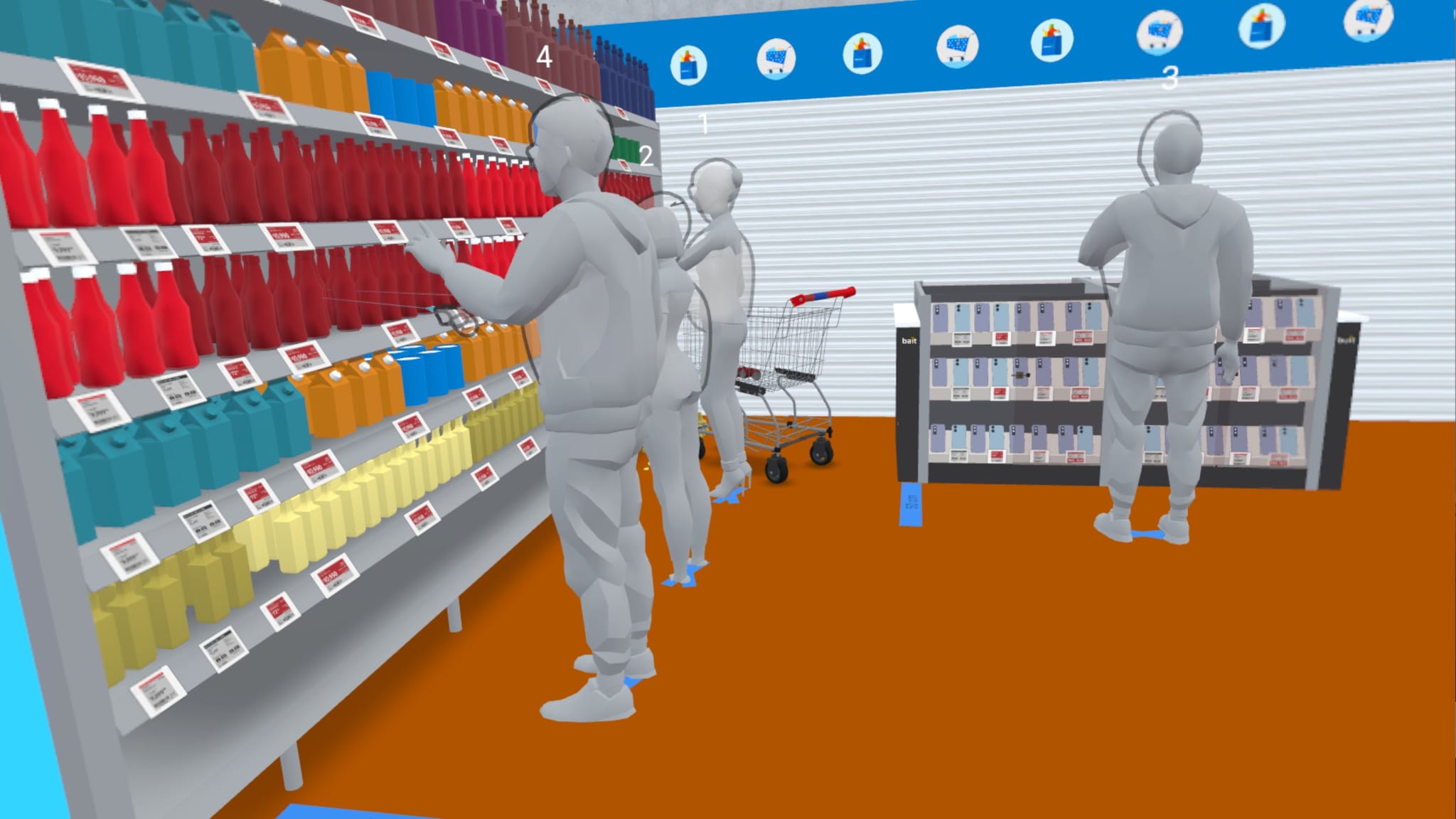
Walmart Mexico's UX lead, Daniel Sánchez Taza, proposed virtual reality as an intermediate research environment between interface design and physical-store validation. A representative retail environment was built in ShapesXR, and label alternatives created in Figma were placed onto virtual shelving. Participants experienced the environment through a Meta Quest 3. Four avatar viewpoints were positioned at different distances and heights relative to the shelves, using average Mexican population references, so the team could evaluate readability from reproducible customer perspectives.
The team evaluated typography, information hierarchy, layout, color, shelf position, viewing distance, viewing angle and accessibility. The moderated qualitative evaluation involved four internal participants, including the label designer, and was repeated across three iteration cycles. Each cycle moved from Figma to ShapesXR, VR testing, findings, design iteration and retesting.
Impact & Results
The VR evaluation helped the team discard US label formats early, revise typography and price hierarchy, reposition secondary information and identify shelf-height constraints that affected visibility. Accessibility considerations included lower viewing positions representative of wheelchair users and color-vision simulation checks.
Based on project estimates, an equivalent physical-store testing cycle could require approximately 4-6 weeks, while the VR-assisted validation cycle could be completed in roughly 1-2 weeks, including downtime between activities. After three VR-assisted iteration cycles, the final electronic shelf label designs were approved and implemented in physical Walmart Mexico stores.

