


Overview
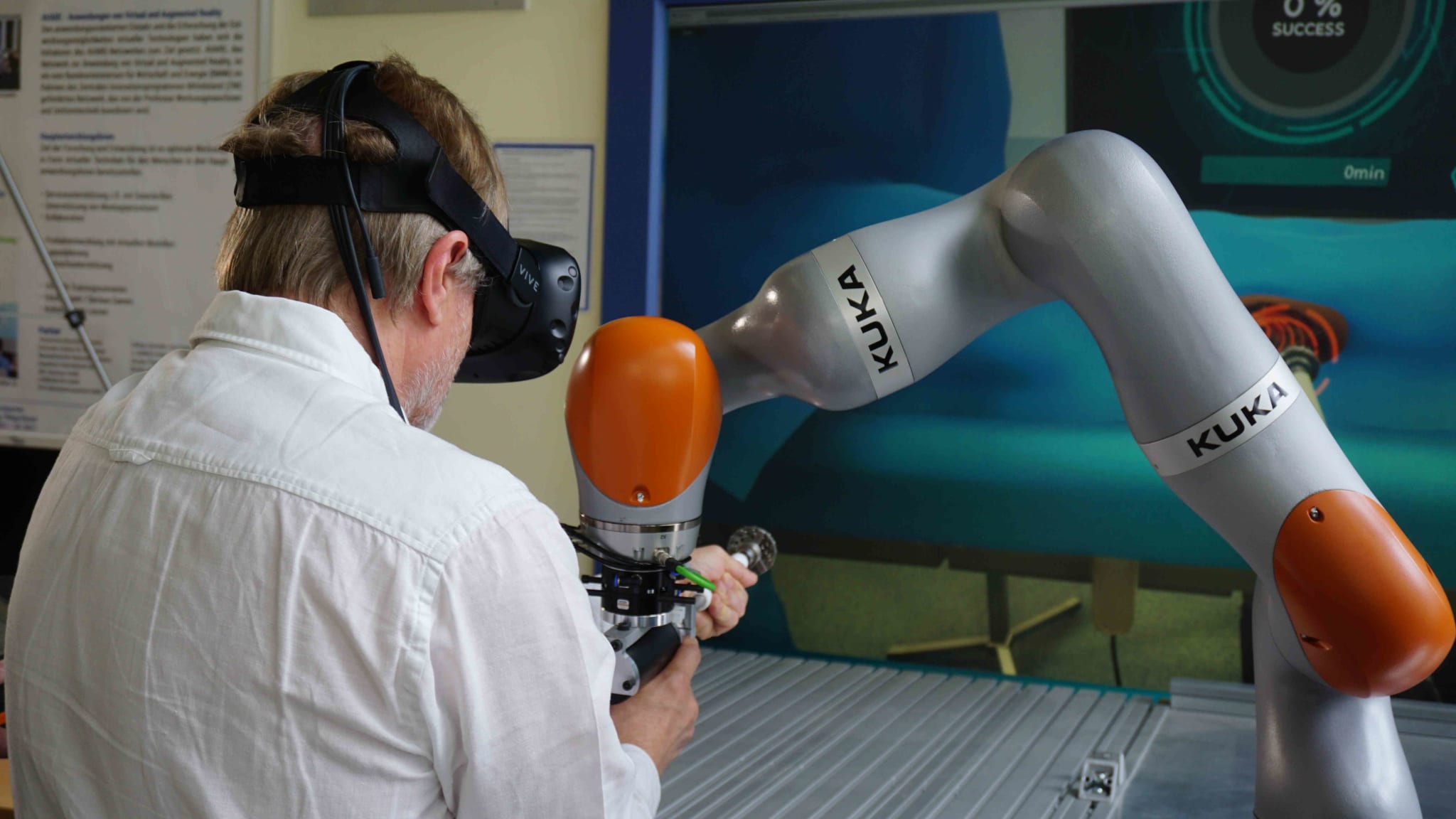
HIPS (Hip-Replacement Implantation Preparation Simulator) is a collaborative research project that helps surgical learners practice hip replacement procedures in virtual reality with haptic and force feedback. It was created to support safer, more effective skills training in arthroplasty, especially for tasks that are difficult to teach solely through observation.
The project addresses a key training challenge in hip surgery: some of the most important skills depend on feeling the right amount of force, timing, and resistance. By simulating these interactions in VR, HIPS offers a controlled training environment that can reduce dependence on donor hips for early-stage practice.
Implementation
The simulator combines virtual reality, high-force haptics, and robotic hardware. A KUKA LBR iiwa robot is used to render hard contact and high-force interactions, while the team developed a collision-detection and force-feedback approach based on inner sphere trees to support stable, continuous haptic rendering.
The first iteration focused on acetabular reaming, a technically difficult stage of hip replacement surgery. The second iteration expanded the system to cover five major procedure steps: femur-head cutting, acetabular reaming, socket implantation, femur rasping, and final joint implantation.
Impact & Results
HIPS has been publicly demonstrated at the European Robotics Forum 2018 and IEEE VR 2018, demonstrating the project’s technical maturity and visibility in the XR and robotics research communities.
The project has also received strong external recognition. It won the DIVR Best Tech award in 2019 and again in 2023. The extended version presented in 2023 showcased haptic simulation across five surgical steps, highlighting the project’s progress from a focused training prototype to a broader procedural simulator.


