

Background
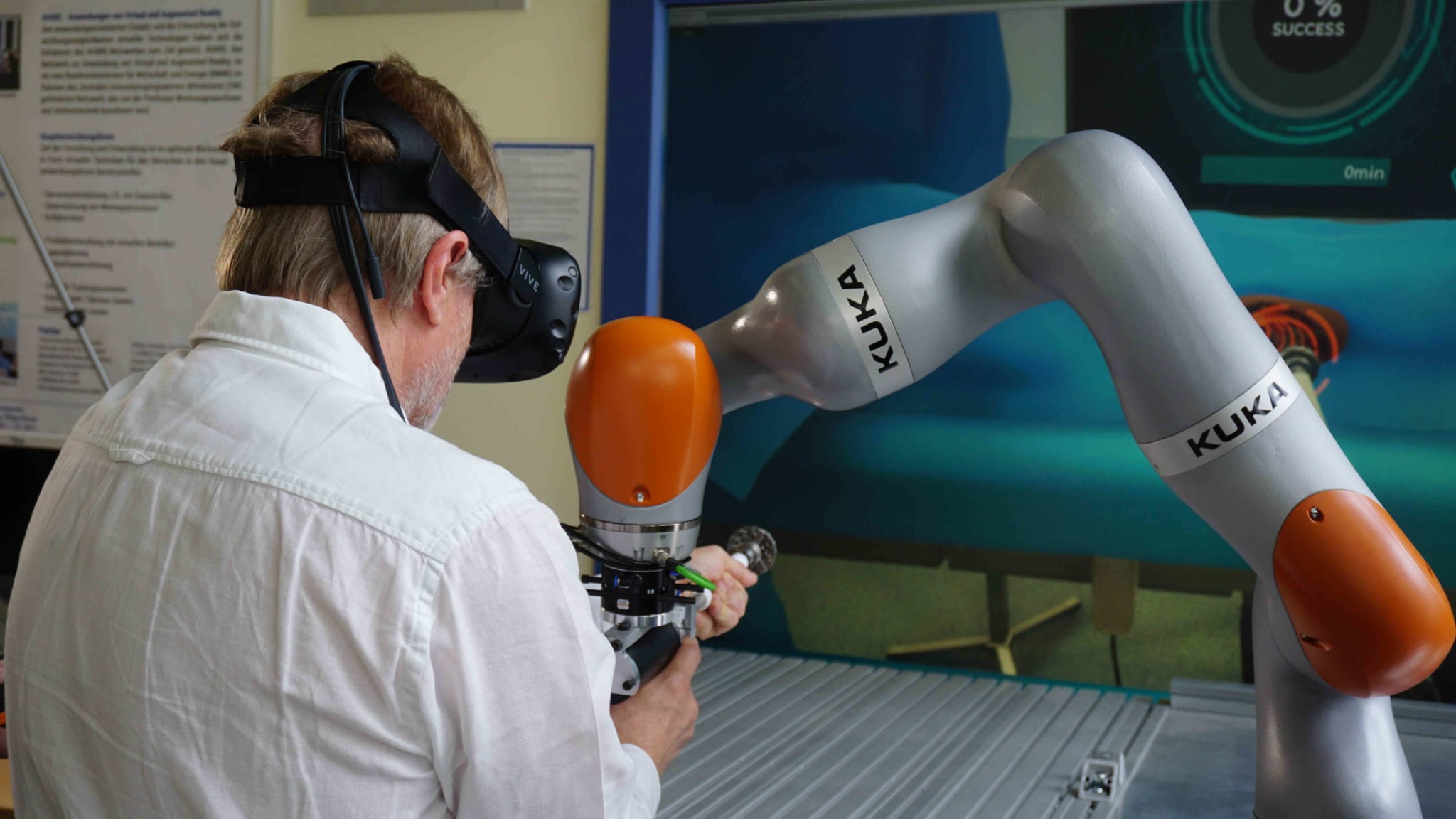
The Computer Graphics and Virtual Reality (CGVR) lab at the University of Bremen, Germany, developed an immersive VR dental simulator for practicing bi-manual manipulation of a surgical drill and dental mirror in a simulated operative environment. The project arose from the well-established gap between traditional phantom-head training and real clinical dexterity: skill acquisition in dentistry requires extensive, deliberate practice of specific fine-motor tasks before any patient contact.
The Simulator
The simulator places the user inside a fully stereoscopic VR environment delivered through a head-mounted display. Both the dental handpiece (drill) and the dental mirror are controlled via Phantom Omni haptic devices (SensAble Technologies), one per hand, providing six-degrees-of-freedom force feedback that simulates the tactile resistance of enamel, dentin, and pulp tissue. Tooth models are constructed in three anatomically verified layers, with material properties modulating drill resistance in real time.
Three mirror-guidance feedback methods were integrated to help users develop indirect-vision alignment skills: visual, verbal, and haptic guidance. The simulator also records tool trajectory and tracks eye gaze throughout each session using the headset's built-in eye-tracking system, enabling post-session review and automated outcome scoring.
User Studies
In December 2021, a user study was conducted in collaboration with the Faculty of Dentistry at Thammasat University, Thailand. Forty fifth-year dental students were trained on root canal access opening in the simulator; errors assessed by two independent expert dentists were reduced following training.
A subsequent randomised controlled trial (RCT), published in BMC Medical Education in October 2025, enrolled 30 fourth-year preclinical students at Thammasat University assigned to either the VR simulator (n = 15) or a standard phantom head (n = 15). All participants completed three one-hour training sessions covering both Traditional Access Cavity (TradAC) and Conservative Access Cavity (ConsAC) preparation techniques. The primary outcome — tooth volume loss measured via micro-CT — showed significant pre-to-post improvements in both groups (p < 0.05), with no significant difference between training methods, demonstrating the VR simulator as a feasible and scalable supplement to conventional preclinical training.
A parallel study published in PLoS ONE (2023) investigated the specific contribution of 3D stereoscopic rendering and hand-tool alignment, training four student groups with different simulator configurations and measuring real-world skill transfer on plastic teeth.
Partners and Funding
The project involved collaboration between the CGVR lab, the Faculty of ICT at Mahidol University (Bangkok), and the Faculty of Dentistry at Thammasat University. Funding was partially provided by a Mahidol University Office of International Relations grant supporting the Mahidol-Bremen Medical Informatics Research Unit (MIRU), a fellowship from the Hanse-Wissenschaftskolleg Institute for Advanced Study, and BMWi grant 16KN036252.