


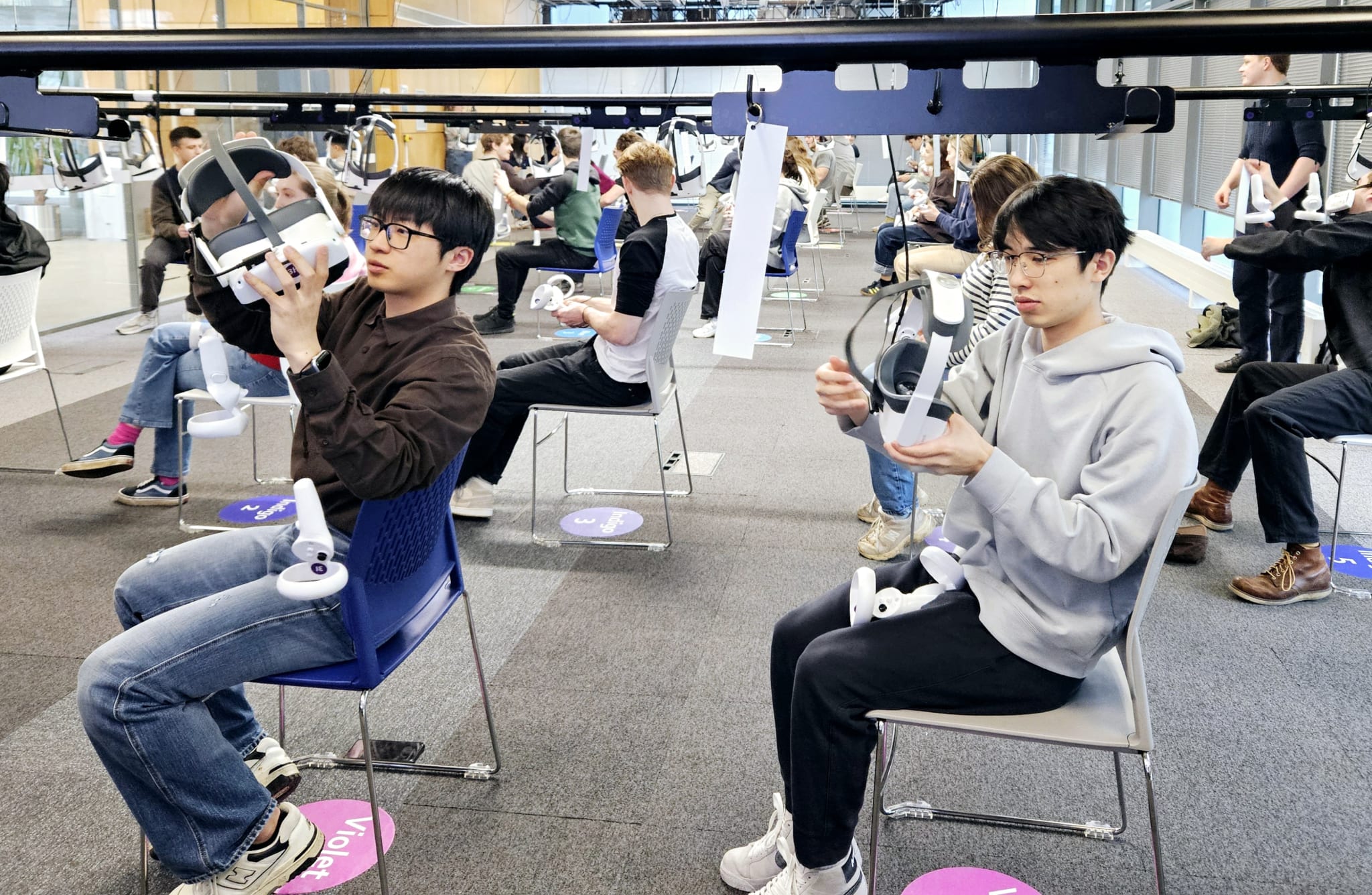
<p>The University of Nottingham's Faculty of Engineering runs a virtual reality classroom in its Engineering Science and Learning Centre (ESLC) on the University Park campus. The university announced it on 12 February 2024, describing that year's second-year Product Design and Manufacture cohort as "the first in the country to benefit from a brand-new virtual reality (VR) classroom that revolutionises the teaching of VR software". That cohort was already using the room when the announcement was published and no separate opening date is given, so the deployment start is recorded at year precision for 2024.</p>
<p><strong>What is installed.</strong> The room contains "40, high image quality VR headsets, 35 of which are tethered overhead to individual high-power PCs with the remaining five consisting of more traditional desk-based systems with display screens", so that students "can choose the way they want to learn and experience VR". The department's own facilities page adds that the headsets "hang from four 'station rigs' on the ceiling which, when raised up, allows the room to be reconfigured for other activities", and puts the cost at "GBP238,000", calling it "the first-of-a-kind in a UK university". A further "90 wireless headsets are available to loan to students" for use in any location so they can continue studying outside the classroom, and there is staff and student access to "several 3D scanners and 360 stereoscopic cameras"; a separate VR workshop in the same department holds several different types of VR headsets and 3D scanners. Neither headset vendor nor model is named in the announcement, in any of its syndications or on the faculty page, and no software title is named there either.</p>
<p><strong>How it is used.</strong> The classroom "enables remote viewing and communication between lecturers and students in a way that's never been done before". A further stated aim is real-time collaboration across the university's international campuses: the Ningbo campus has its own VR lab, so students in different countries can work together in labs or in design-based exercises. Supported by a specialist technician, the faculty says custom environments and objects for teaching a range of engineering and architecture subjects will be developed and access widened to students on other courses in the coming years - a plan rather than confirmed operation.</p>
<p><strong>Context.</strong> The faculty says it already ran smaller VR labs before this classroom and describes the new facility as being at a scale beyond them. The Faculty of Engineering has six departments, more than 5,600 students and 800 staff. No funder or funding scheme is named for the classroom, and no usage or outcome figures have been published since the launch announcement.</p>
<p>This VR classroom is a separate deployment from the university's Virtual and Immersive Production Studio at the King's Meadow campus, from the Mixed Reality Laboratory in the School of Computer Science, and from the faculty's earlier desktop-VR teaching module of 2020; they should not be merged.</p>
Data Points (5)
Quotes
“While many universities, including us, have existing VR labs, these are nowhere near the scale of our newly unveiled facilities, which will provide our students with access to cutting edge tools and technologies unlike anything else on offer across the globe.”
“We have a desire to be at the forefront of technology in teaching and we've already been making strides in this area in recent years in our smaller VR labs. Now, however, we have the opportunity to take the lead in the UK and further build our reputation for producing engineers that are ready to shape the real world.”
“The virtual reality classroom is an incredibly exciting addition to our teaching facilities as we continue to position ourselves at the forefront of VR teaching. We believe that great minds don't think alike, which is why we want to provide our students with a truly unique experience.”


