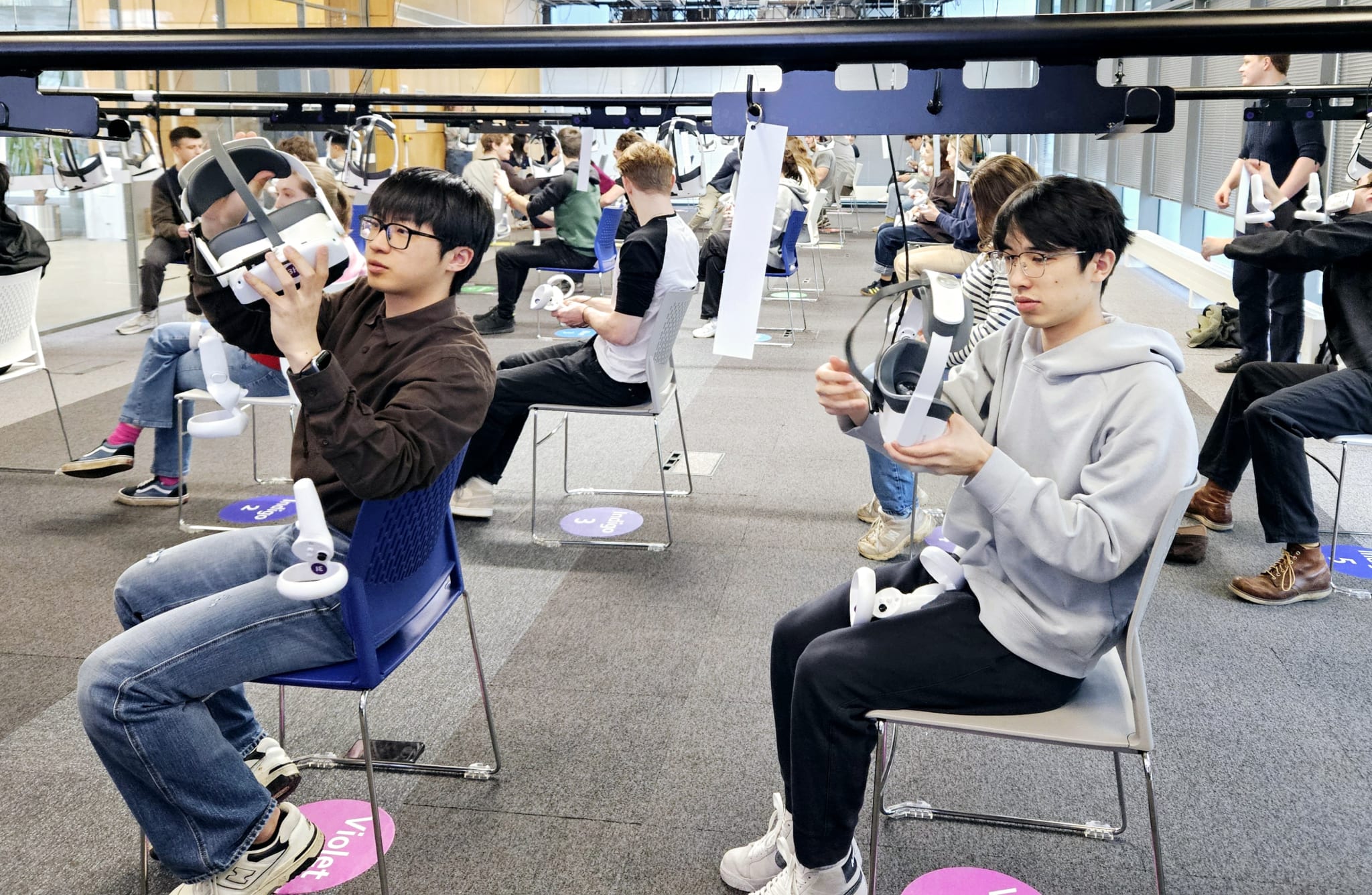


The University of Nottingham’s Virtual and Immersive Production Studio (VIP Studio) helps researchers, artists, small businesses and community groups create immersive experiences for film, television, games and performance. The cross-faculty facility brings together creative practice and computer science in Studio 11 at King’s Meadow campus, Nottingham.
Capture and production facilities
The studio’s published equipment inventory includes a 16-camera Vicon motion capture system, a 10-camera Scatter volumetric capture system, Faceware Mark IV facial performance capture, three Teslasuit motion capture and haptic feedback suits, a Varjo XR-3 and 15 Meta Quest 2 headsets. The School of Computer Science also lists Apple mixed reality devices, without specifying models or quantities.
Production facilities include green-screen stages, camera tracking, projectors, film cameras, lighting and drones. Stereo, binaural and ambisonic recording and playback support spatial sound production. These tools support immersive theatre, AR applications, mixed-media games, digital performances, VR training, dance and circus experiences, and projection mapping.
Artist residencies and creative work
GLoW3 artists and King’s Digital Lab used the studio’s motion capture facilities to explore AI and immersive art. Lumo Company also undertook a residency experimenting with an immersive circus experience.
The Arts Council England-funded Open Online Theatre residency of 2024/25 involved 13 multidisciplinary artists. An intensive week in October 2024 introduced motion capture, photogrammetry, volumetric capture, Unreal Engine, VR and AI. The programme led to work presented through OOTFest25 at Riverside Studios in London in June 2025.
A February 2026 Create Growth N2 case study describes Terra Nova, an immersive storytelling collaboration between artist Usha Mahenthiralingam and Richard Ramchurn, with Albino mosquito and VIP Studio XR developer Iram Shaheen. Supported by an AHRC Impact Acceleration Account grant, the project explored ecology, health and the built environment through Gaussian splats, motion capture and generative AI. At the time of the report, the team was developing work-in-progress presentations and seeking further support towards a film.
Business support and 2026 activity
The studio reports that Create Growth N2 has completed delivery across Nottinghamshire. The partnership’s programme included six immersive technology cohorts. Its wider results—250 businesses engaged, 302 individual advice sessions, 104 workshops and more than £1.3 million secured in competitive innovation and Arts Council funding—cover the whole programme and its partners, rather than the VIP Studio alone.
The advertised programme for the XR Network+ roadshow at the studio on 24 March 2026 included a workshop demonstrating AI Lens. Developed at the VIP Studio with funding through the University of Nottingham-led Somabotics project, this camera system transforms live video using generative AI. The event programme offered studio tours and discussion of accessibility and future virtual production research.
Origins, funding and access
The university announced the studio on 24 March 2023. It occupies a former ITV television studio and was created through the ERDF-funded LEADD:NG programme. The School of Computer Science identifies ERDF, the European Commission, the Department for Culture, Media and Sport, and UK Research and Innovation as funding sources for the facility. Individual residencies and research projects have their own funding arrangements.
Led by Professor Helen Kennedy, the studio offers hire with or without onsite technical support, alongside research collaboration and training. It aims to widen access to immersive production for creative practitioners and communities who might otherwise lack access to specialist facilities.
Its sustainability approach includes reusing an existing studio building, sharing and loaning equipment, redistributing resources through WarpIt and following albert production guidance.