


Background
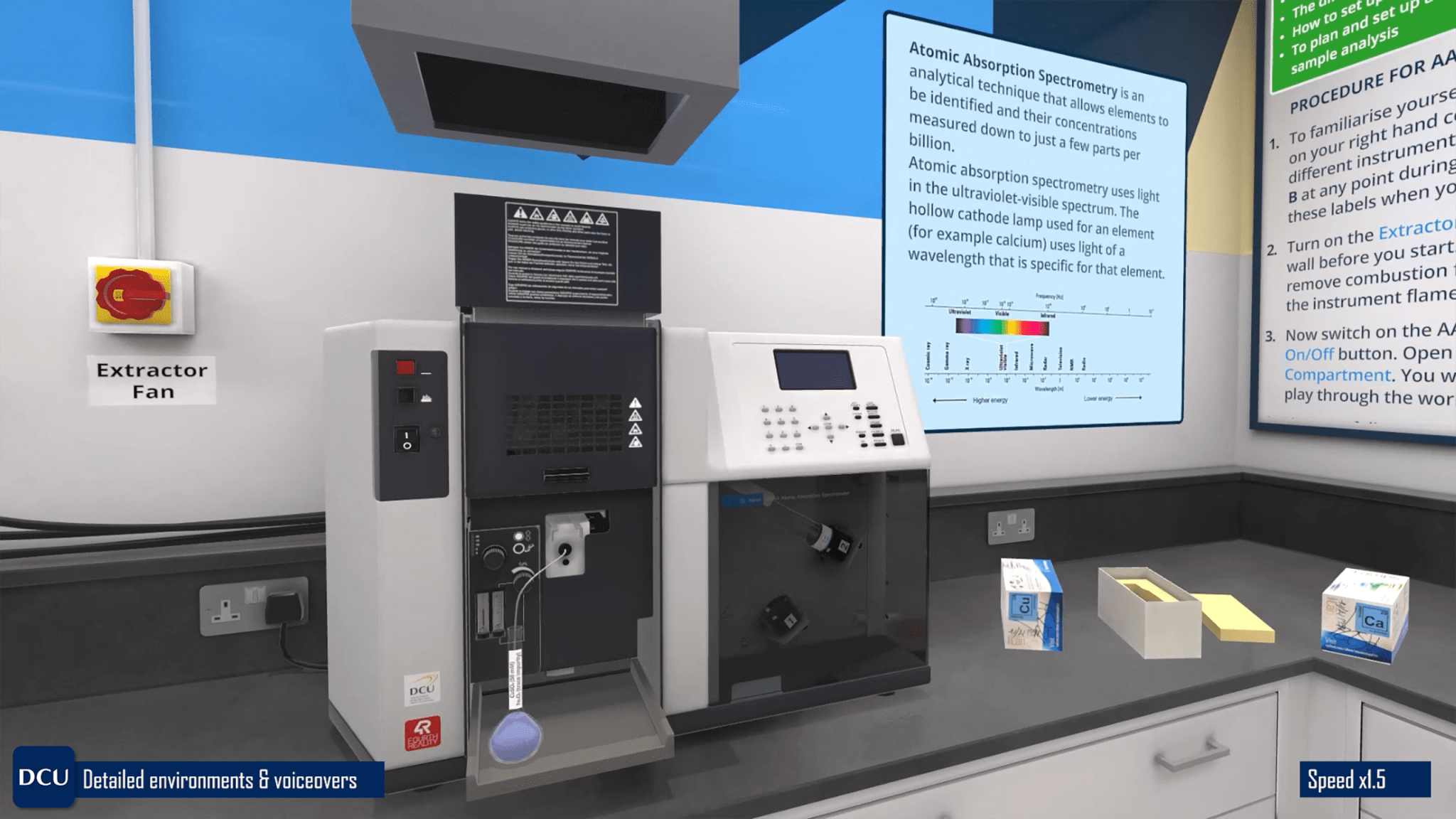
Dublin City University (DCU) developed an immersive virtual reality chemistry laboratory to train third-level chemistry undergraduates in analytical techniques for quantitative chemistry. Built with VR studio Fourth Reality, the Immersive ChemLab lets students perform metal-ion analysis using flame Atomic Absorption Spectrometry (AAS), gaining hands-on experience operating lab instrumentation, optimising conditions, and undertaking quantitative analysis in a hazard-free environment.
The lab was designed for the School of Chemical Sciences at DCU, where students often have only around six hours to learn complex instruments and software. The developers note the experience also has potential as an introduction to analytical chemistry for second- and even primary-level students.
The deployment
Students are guided through multiple modules with detailed, interactive environments, contextual voice-overs, and a variety of tasks to complete. The simulation behaves like a genuine virtual twin of the real instrument, building familiarity, confidence, and efficiency before students ever set foot in the physical lab — even among those with no prior VR experience. The experience is incorporated into the standard curriculum.
The Immersive ChemLab - AAS application is published on the Meta Store, and the programme has since expanded with additional modules such as Ion Chromatography.
Hardware and software
- VR experience developed by Fourth Reality
- Delivered as a standalone Meta Quest application (the DCU virtual labs ran on Meta Quest 2 headsets)
- Guided, interactive modules with contextual voice-over narration
Wider programme and recognition
The work is part of the Virtual Labs Project (2020–2026), a large-scale collaboration across five Irish higher-education institutions — led by Maynooth University, with DCU, University College Cork, Dundalk Institute of Technology, and the Technological University of the Shannon — focused on using virtual laboratories as a teaching tool for the chemical sciences. Funded under the Higher Education Authority's Human Capital Initiative (Pillar 3), the project team won the Royal Society of Chemistry 2025 Team Prize for Excellence in Higher Education.