

ArcelorMittal France has built two Digital Labs, at Dunkerque (Nord) and at Uckange (Moselle), next to its Florange plant, as part of a digital transformation programme aimed at moving its French steel operations towards Industry 4.0, training employees and stimulating the local economies around its plants. ArcelorMittal brands the second lab "Digital Lab Florange" after the neighbouring works, while Immersion's case study lists it under the town it actually occupies, Uckange.
ArcelorMittal inaugurated the Dunkerque lab on 6 July 2021 and said it would open to users that September; the Uckange lab was inaugurated on 9 February 2022. Both were still operating at the time of writing, with lab events listed by ArcelorMittal through June 2026.
Immersion, a Bordeaux company specialising in virtual and augmented reality and collaborative systems, supplied the immersive and collaborative rooms. Its case study describes the Dunkerque building, which extends over 2,700 m2, as containing an immersive room for design work with a Meetiiim collaborative touch table, a mobile touch screen and a video projection wall; a stereoscopic room for collaborative work with a collaborative touch screen and a 3D video projection wall; and a large touch wall used to welcome visitors, which can be customised for the events or start-ups using the space. All of these run Shariiing, Immersion's presentation and collaboration software.
In its February 2022 press release Immersion gave the combined figures for the two labs: three large touch walls (2 m by 2.50 m; a second over 2 m high by nearly 2 m wide; and one 98-inch), two Meetiiim collaborative touch tables and two 85-inch collaborative touch screens; two virtual reality rooms with stereoscopic 3D projection walls measuring 5.40 m by 2 m and 6 m by 2 m; and one immersive room with a 2D projection wall of 6 m by 2 m. The same release said the two labs would be interconnected through Shariiing to bring people and territories closer together. That interconnection was stated in the future tense at the time and no later source confirms it was commissioned, so it should be treated as planned rather than verified in operation.
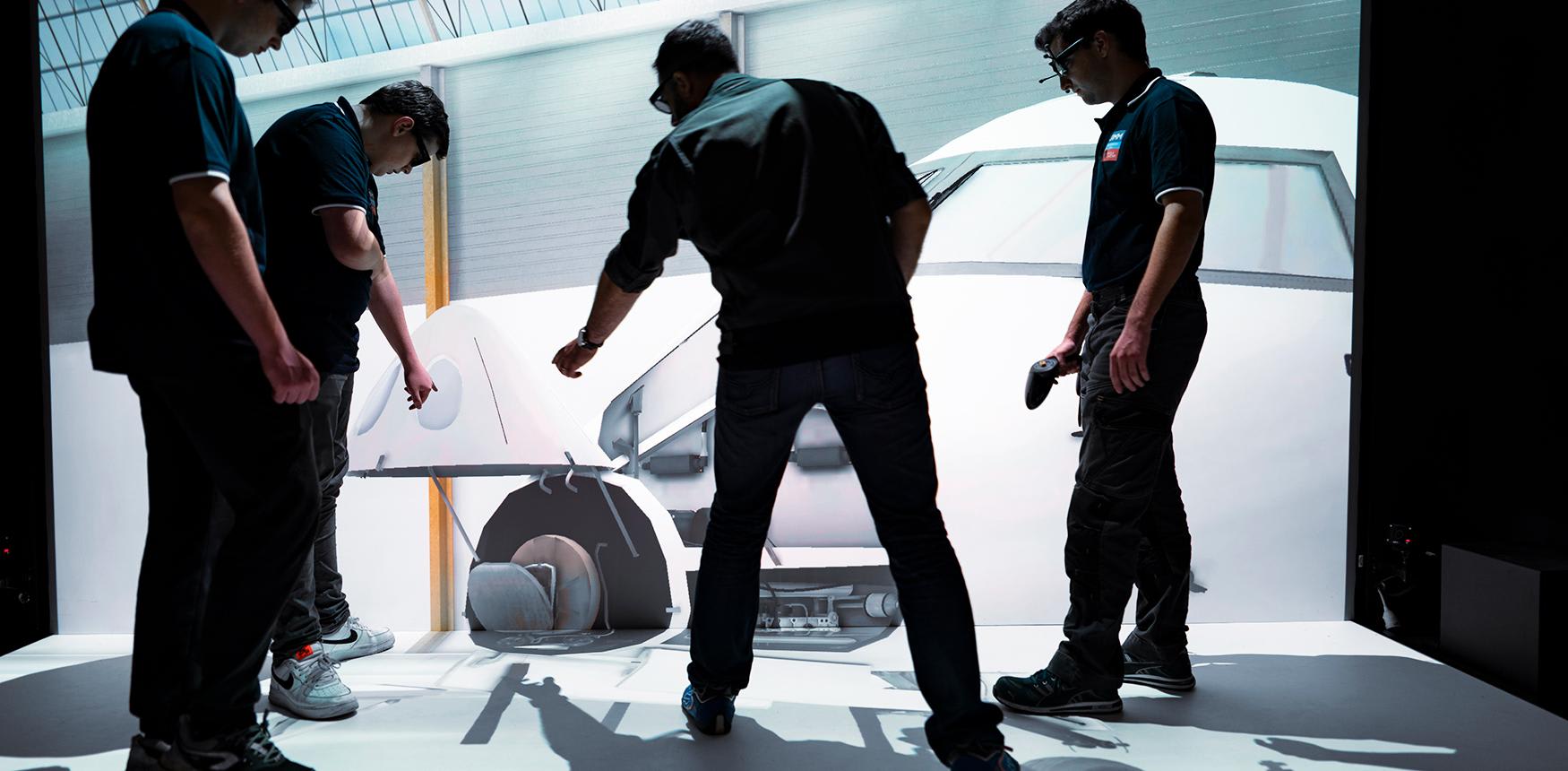
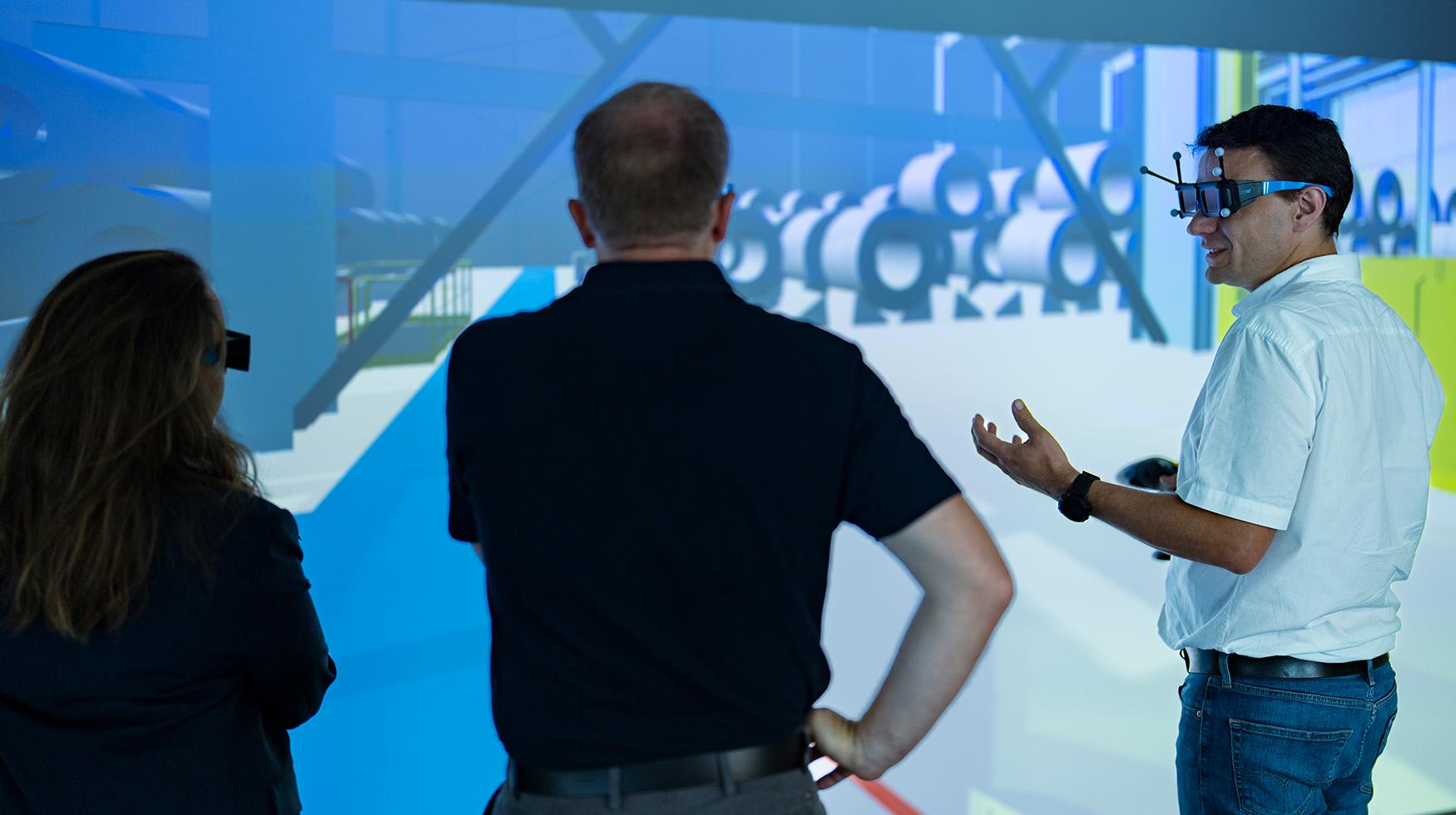
Photographs published with the case study show the stereoscopic room in use: participants wear active stereo 3D glasses, one pair fitted with a reflective optical tracking target, and one holds a handheld wand controller while reviewing a 3D model of plant structures and steel coil storage on the projection wall. Ceiling-mounted projector pairs and wall-bracketed tracking cameras are visible in the room photographs. The exact tracking system, real-time engine and input degrees of freedom are not stated in any source.
The labs serve co-development with start-ups, local authorities, industrial partners, universities and grandes ecoles; training for ArcelorMittal employees and external participants in new technologies and digital culture; and outward-facing conferences and events. Dunkerque concentrates on workplace safety, energy and the environment; Uckange on quality 4.0, data intelligence and maintenance 4.0. ArcelorMittal's own release describes the Dunkerque facility as 2,700 m2 with capacity for 200 people, five coworking rooms, three immersion rooms of which one is virtual reality, a 200 m2 creativity room and 135 screens including 12 giant screens and 11 large touch screens; the Uckange lab occupies over 2,000 m2 in a renovated building owned by the Communaute d'Agglomeration du Val de Fensch that formerly housed the Lorfonte works' "Grands Bureaux".
The engagement followed an earlier collaboration: from 2019 Immersion supplied ArcelorMittal with a mixed reality solution, running on Microsoft HoloLens 2, used to check the conformity of steel coil packaging before shipping, and remote maintenance assistance. Those are separate deployments from the lab fit-out described here.
Immersion says the installation was delivered against a limited budget and a tight schedule, and that it appointed an architect as project manager for the first time on this project, a method it has since applied to other projects. No contract value, user numbers for the immersive rooms, or measured results have been published.