


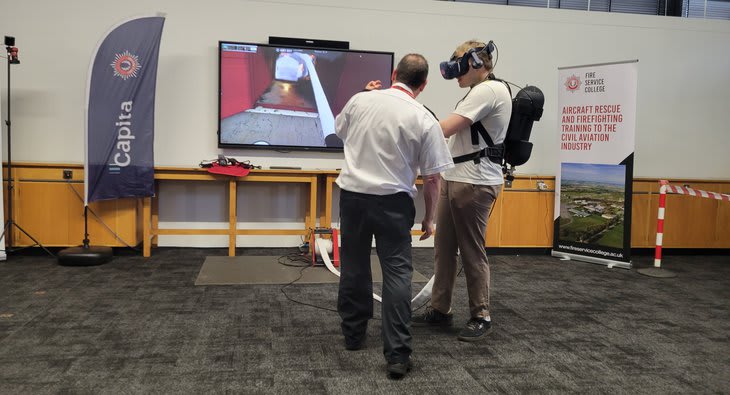
The Fire Service College at Moreton-in-Marsh, Gloucestershire — the UK's national firefighter training centre, operated by Capita on a 300-acre site — has added virtual reality to its recruit and specialist training programmes alongside its live-fire incident ground.
Two VR programmes run on tethered PC-driven HTC headsets. RiVR Investigate places fire investigators inside photogrammetry scans of real burn scenes: every object can be picked up and examined with virtual torches, cameras, a dictaphone and a scene light, and trainees can replay recorded footage of the actual fire to check their conclusions. RiVR's co-founder Alex Harvey told the BBC the software had been in development for four years. FLAIM Trainer covers suppression, pairing a heat-generating haptic vest, a faux breathing-apparatus set and a hose controller on a motorised spool that winches back to mimic the pull of a charged line; scenarios shown to visiting journalists in July 2024 included an aircraft engine fire, a petrol-station forecourt and a domestic garage. HTC VIVE Tracker 3.0 units track the haptic hardware, and the fire-investigation experience is built in Unreal Engine.
The college frames the technology as blended rather than replacement training. Instructors keep trainees on the physical incident ground, but VR removes repetitions that would otherwise be run in carcinogenic smoke and reduces reliance on controlled burns, which RiVR puts at roughly £5,000 each and which can only be used once before the scene is disturbed. The Fire Service College's own innovation pages list RiVR Investigate, RiVR Link — an instructor tool for casting, annotating and pausing a trainee's headset view — and FLAIM Trainer among its immersive offerings, and the college opened a dedicated Immersive Skills Lab with free-roam VR in February 2025.


