


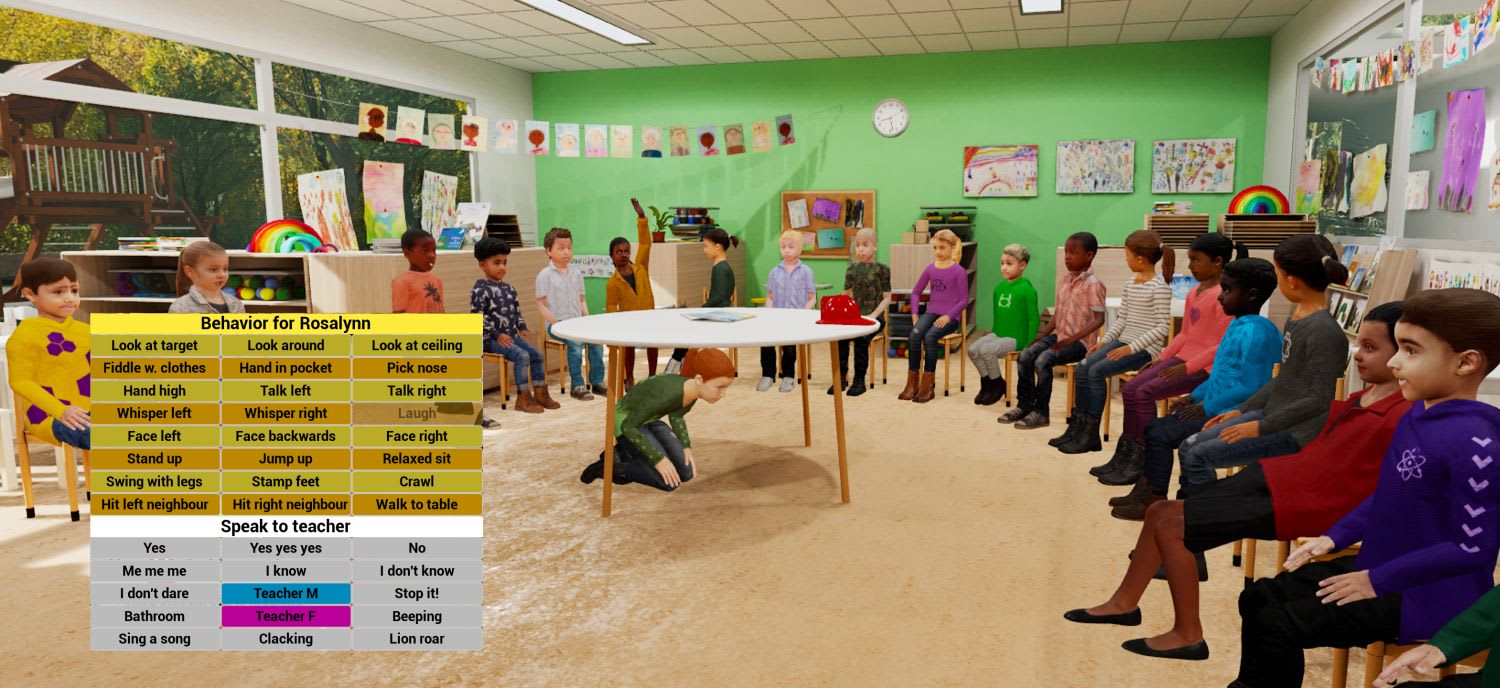
The University of Groningen's Center for Information Technology (CIT) built a real-time 3D virtual kindergarten classroom so that trainee primary-school teachers can practise classroom management before they face a real class. Wearing a VR headset, the student stands in front of a room of preschooler avatars and works through disruptions - a child crawling under a table, an ambulance passing loudly outside the window - trying out the constructive strategies taught in their coursework.
A supervising tutor drives the session from outside the headset, choosing between scenarios and switching individual behaviours on or off mid-simulation to give the student more room or more of a challenge. Each behaviour has consequences if it is not addressed in time, and a scenario can be replayed as often as needed. That is what the project team means by a safe practice environment: unlike a real placement, mistakes cost nothing.
The environment was designed by CIT's Visualization team together with Jolien Mouw of Educational Sciences, who created the educational innovation, after the idea surfaced at the XR hub the CIT has run since 2017. It was first used with students in the 2020-2021 academic year and has since gained further scenarios and integrated eye tracking. It is now part of the University's academic primary teacher-training programme, used by 81 students there, while roughly 200 more at Christelijke Hogeschool Ede, Saxion and Thomas More Hogeschool use it in their pabo programmes and contribute to its further development.
In June 2024 the project, 'De Klas op Orde met Virtual Reality', won the Nederlandse Onderwijspremie (Dutch Education Prize) - the highest award in Dutch vocational and higher education - together with EUR 1.2 million from the Netherlands Initiative for Educational Research to develop and scale it further. A subsequent review of that scale-up by the project team found take-up varies by institution and year group, and that technical failures, timetabling and tutors' own confidence with the equipment materially affect how well it lands.


