


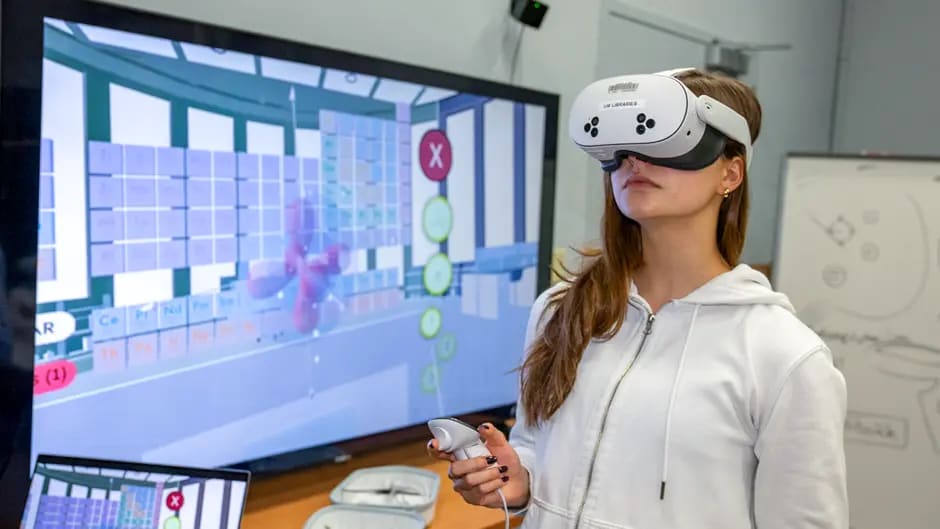
The University of Miami's Virtual Experiences Simulation Lab (VESL) spent over a year developing a mixed reality application that allows chemistry students to interact with three-dimensional atomic structures and electron orbitals at a scale that textbooks cannot convey. Built for Meta Quest headsets, the application supports two modes: a full VR mode that places students in an isolated virtual environment surrounded by atomic models, and an AR mode that overlays the periodic table and atomic structures onto real classroom spaces. Students can select any element from the periodic table, examine its electron orbital configurations, and compare structures side by side — experiencing atomic geometry as a tangible, explorable space rather than a flat diagram. Marc Knecht, Chemistry Professor and Department Chair, noted that chemistry constantly challenges students to reason about phenomena at extreme scales, and that mixed reality offers a uniquely powerful tool for building that spatial intuition. Students piloted the application in first-year chemistry courses, with participants describing how the format helped them understand orbital layering and atomic behaviour in ways that textbooks and slides could not achieve. The lab is developing multi-user functionality to support lecture hall settings, with plans to expand the application into modelling chemical reactivity and molecular binding. Funding for the project came through a Faculty XR Award, and the application is housed at the Otto G. Richter Library's XR Community Lab on the Coral Gables campus.
Quotes
“Students often have a hard time conceptualizing when things are incredibly small and incredibly large, and that's what we deal with in chemistry.”
“This is one way that mixed reality can be a very powerful tool. There's something to be said about being able to touch, see, and feel things in 3D.”
“Now I can see how all of the orbitals layer on top of each other.”
“When you see atoms of elements on slides in class or in a textbook, it's hard to see what's really going on.”
“Seeing it like this really helps a lot and gives you a better idea of what's going on.”
“A lot of us have experiences with chemistry textbooks that did not go well.”


