


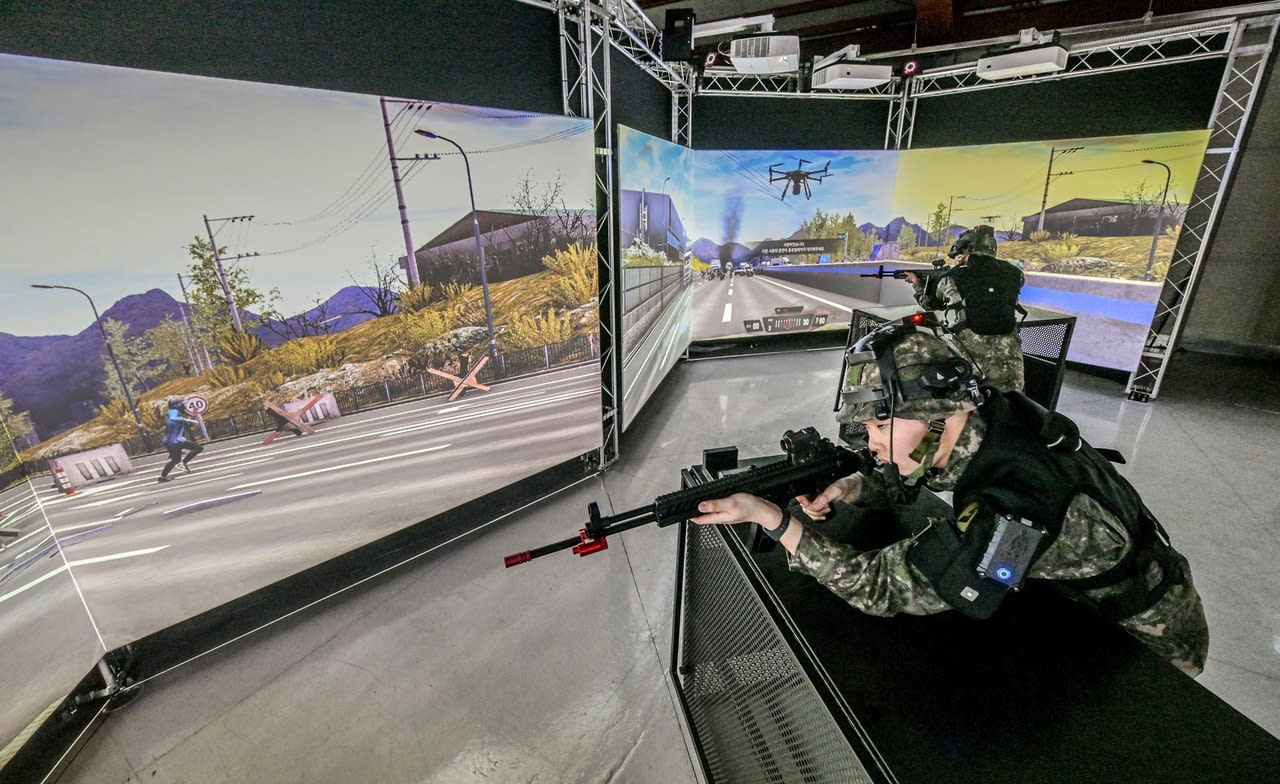
The Republic of Korea Army has built a nationwide network of technology-integrated reserve training facilities, reaching 29 centers since the first opened in Namyangju in 2014. The flagship experience at each center is a multi-screen VR shooting simulator that recreates urban combat environments based on real Seoul landmarks including Hannam Bridge, Seocho Station, and Coex.
Trainees wear sensor-equipped helmets and electronic vests that deliver haptic feedback — vibrations to the chest, shoulders, or thighs — simulating the physical sensation of being struck, while operating mock rifles with recoil simulation. The three-sided multiscreen display immerses trainees in the simulated battlefield without the use of personal head-mounted displays. CPR training is enhanced through sensor-equipped digital mannequins that measure compression depth, speed, and accuracy in real time, transmitting data via Bluetooth to a central display showing whether compressions meet medical standards.
Five additional centers are scheduled to open in 2026 in Mokpo, Daejeon, Chilgok, Yeongcheon, and Andong, with a long-term target of 40 facilities nationwide. The expansion is designed to modernise reserve force readiness and combat effectiveness while adapting to demographic pressures from South Korea's declining military-age population.


