


Background
At Fort Bliss, Texas, Soldiers and leaders across the 1st Armored Division evaluated how augmented and virtual reality could reshape vehicle maintenance, training, and readiness. During an April 2026 demonstration, maintainers were introduced to a suite of AR-enabled tools built by the U.S. Army Combat Capabilities Development Command (DEVCOM) Armaments Center and its Net Centric Maintenance Armament Readiness Technologies Division. The tools combine traditional technical manuals with digital overlays, letting maintainers see step-by-step instructions directly on the equipment in front of them.
EMMA: an on-device guide
The Enhanced Multi-Sensory Maintenance Assistant (EMMA) is a local, on-device guide that a maintainer operates by voice and hand gesture, with information presented directly in their line of sight. Through EMMA, Soldiers can pull up schematics, warnings, videos, and interactive 3D overlays aligned to specific platforms, including the Bradley Fighting Vehicle, the Paladin self-propelled howitzer, and the M777 howitzer. Multiple users can work through the same procedure together, keeping maintenance teams synchronized. Critically, EMMA is designed to run entirely on a headset or tablet with no external connectivity — a requirement for disconnected or deployed field operations.
ARMS: reaching back to an expert
Where EMMA works locally, the Augmented Reality Maintenance System (ARMS) extends support beyond the immediate workspace. Using ARMS, a remote subject-matter expert can see exactly what a maintainer sees, mark up their field of view, and provide live guidance — letting a Soldier who does not know a system complete the work without waiting days for someone to travel to the site. Leaders at the demonstration described repair tasks that once took about an hour being finished in 15 to 20 minutes, and framed the shift as moving maintenance from simple part replacement toward collaborative, data-driven diagnostics.
Training in virtual reality
Because the underlying content is virtual, the same platform supports training as well as live maintenance. Through VR, Soldiers can rehearse maintenance procedures on virtual systems when physical equipment is unavailable, building repetition and proficiency without adding wear to real vehicles. Junior maintainers highlighted the value for newcomers, noting that the system can point out parts inside a vehicle and show exactly where to go.
Hardware and outlook
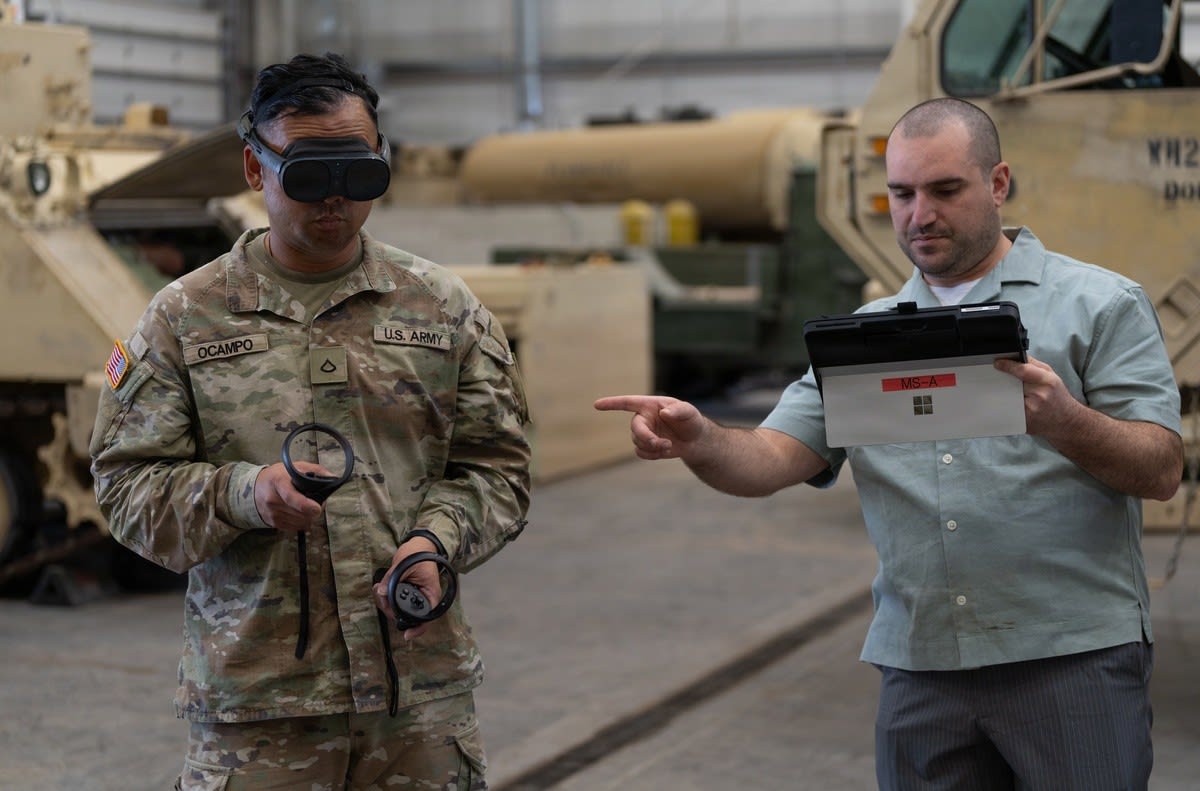
At the demonstration, maintainers used a VR headset with hand controllers alongside a linked tablet, while a separate AR headset overlaid maintenance information onto the vehicle itself. The longer-term vision is to connect these tools with digital logistics systems, maintenance records, and diagnostic data into a fully connected maintenance ecosystem — so that any maintainer, anywhere, can reach back to the person who knows a system best and return equipment to mission-ready status faster.


