


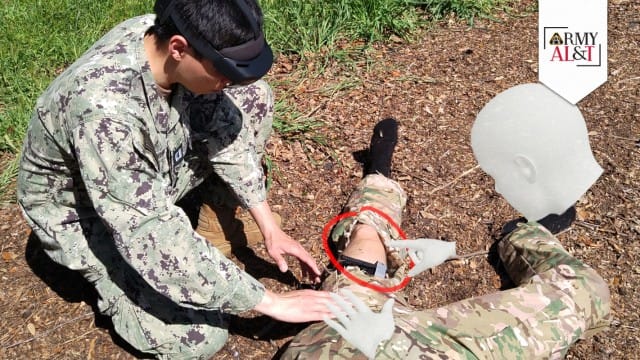
The U.S. Army Research Institute of Environmental Medicine (USARIEM), at Natick, Massachusetts, has built augmented reality software for the Army's Integrated Visual Augmentation System (IVAS) goggles that lets a combat medic or Navy hospital corpsman "see" inside a casualty. A morphed version of a preprogrammed 3D anatomy model is registered onto the medic's real-world view of the wounded warfighter; brief spoken commands switch between anatomical systems, so a medic treating a leg wound can call up the femur, tibia or fibula, and advisory text from the Tactical Combat Casualty Care Quick Reference Guide can be listed alongside the scene.
Industry collaborator Nakamir Inc. added a "virtual expert": the hands of the user or a senior medical professional, recorded in an earlier rehearsal session, replay inside the IVAS field of view to guide a procedure. The system needs no network or cloud connection, so it works in austere domestic and overseas settings.
The effort began in 2019, when the Defense Health Agency's Small Business Innovation Research programme awarded Phase I contracts titled "Augmented Reality Surgical Visualization Tool for Combat Casualty Care" to Augmntr Inc., Computational Fluid Dynamics Research Corp. and Nakamir. USARIEM was already developing individualised anatomy avatars, working with medics from the Farrelly Health Clinic at Fort Riley, Kansas and the Texas Army National Guard; an avatar can be computed from a body scan taken in basic training and refined with DXA data. Nakamir's follow-on Phase II work is catalogued on SBIR.gov as AR-TC3, adding rehearsal and remote-guidance modules.
As of July 2025 the tool had been demonstrated at several Army, National Guard and Navy sites and was being evaluated for transition to the U.S. Marine Corps. Navy Lt. Anh Nguyen, a master's student in the Cyber Systems and Operations Department at the Naval Postgraduate School, is quantifying its training effectiveness and the physical and psychological effects of prolonged AR use for his thesis. It is not yet fielded: the Army describes a capability that will "soon" reach medics and corpsmen.


