


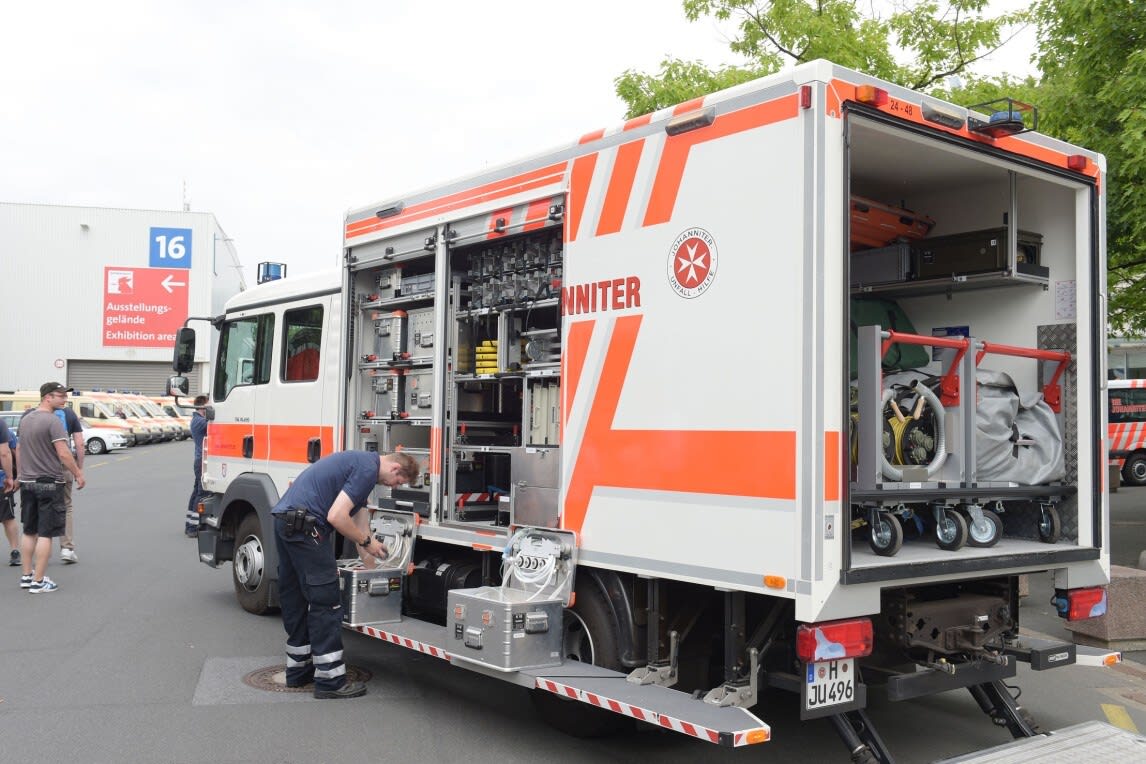
The Johanniter-Akademie Niedersachsen/Bremen, based in Hannover, operates one of Germany's leading emergency services training facilities. The academy serves approximately 3,500 participants per year across around 70 seminars, running nine emergency medical technician classes annually with 17 to 21 students per cohort. Demand for training is high — approximately 20 applicants compete for each available place.
At the heart of the facility is the SAN-Arena, a 500-square-metre space designed to simulate the full spectrum of emergency scenarios. The arena includes a realistic accident simulation zone, a Christoph Life helicopter simulator, a school ambulance, a residential apartment set, and a shock room. These physical environments support more than 20 distinct training scenarios, enabling interprofessional teams to practise coordinated response under realistic conditions.
To extend and deepen this training environment, the academy has integrated VR headsets through the ViTAWiN project — a research initiative funded by the German Federal Ministry of Education and Research (Bundesministerium für Bildung und Forschung). The project develops VR-based tools for interprofessional emergency care training, allowing practitioners from different disciplines to rehearse joint responses to critical incidents in immersive virtual environments.
Director Kersten Enke has highlighted the practical value of the technology, noting that approximately 20 minutes of acclimatisation is typically required before trainees are comfortable in the VR environment. Despite this onboarding time, Enke has described the use of VR headsets as already extremely helpful in the training context.


